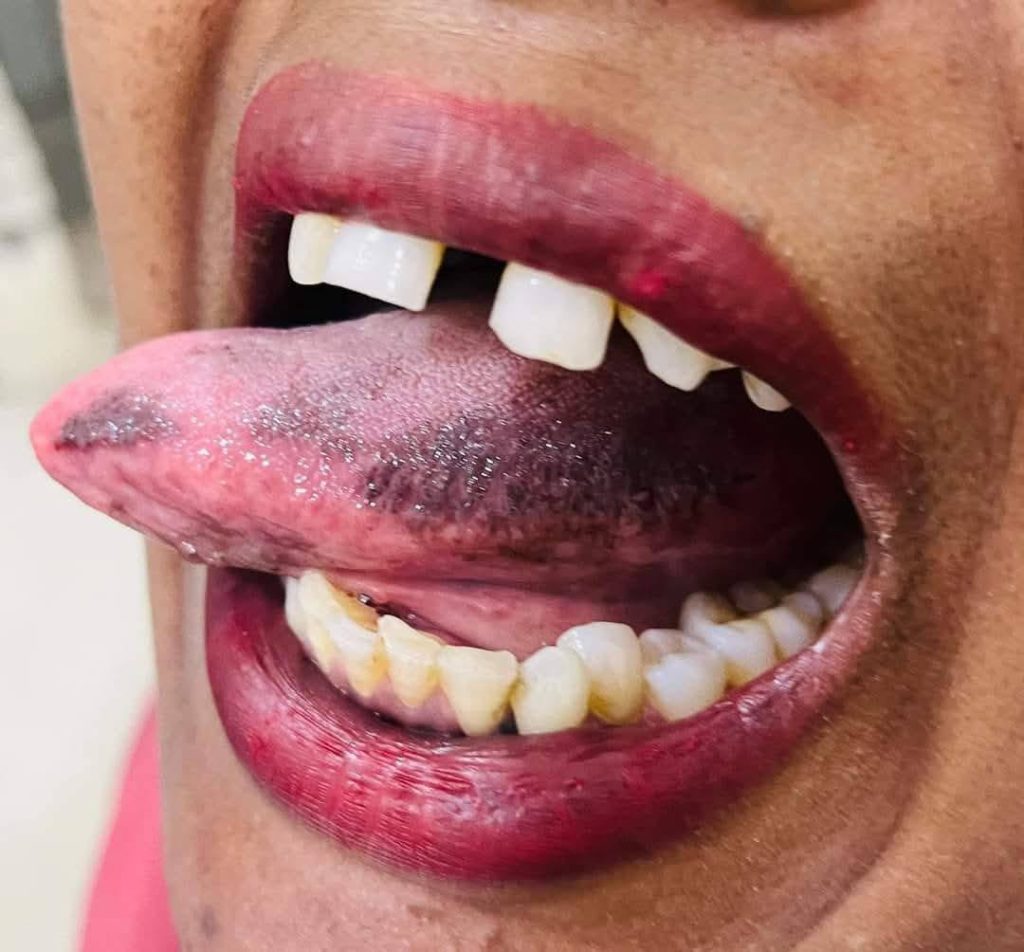
25 year female came to your chamber with following hyperpignented lesion over tongue for more than year.
What are the DD you will consider.
What is the best investigation for this case.
Differential Diagnoses for Hyperpigmented Lesion on the Tongue
For a 25-year-old female with a hyperpigmented tongue lesion persisting for more than a year, the following differential diagnoses (DD) should be considered:
1. Physiological Pigmentation – Common in darker-skinned individuals, often symmetrical.
2. Smoker’s Melanosis – Due to chronic tobacco exposure, typically on the anterior tongue, buccal mucosa, or gingiva.
3. Fungal Infections (e.g., Black Hairy Tongue) – Caused by an overgrowth of keratinized filiform papillae, often due to poor oral hygiene or smoking.
4. Drug-Induced Pigmentation – Certain medications like minocycline, antimalarials, and chemotherapeutic agents can cause oral pigmentation.
5. Addison’s Disease – Adrenal insufficiency leading to increased ACTH and oral mucosal pigmentation.
6. Peutz-Jeghers Syndrome – Autosomal dominant disorder with mucocutaneous pigmentation and gastrointestinal polyps.
7. Laugier-Hunziker Syndrome – Benign, acquired pigmentation affecting lips and oral mucosa.
8. Post-Inflammatory Hyperpigmentation – Due to trauma, chronic irritation, or healed ulcers.
9. Oral Melanotic Macule – Localized, benign, well-defined pigmentation.
10. Malignant Melanoma (Rare but Serious Consideration) – Irregular borders, rapid growth, and color variations suggest malignancy.
—
Best Investigations for Diagnosis
To confirm the diagnosis, the following investigations are recommended:
1. Clinical History & Examination – Assess for tobacco use, medication history, systemic symptoms (e.g., weight loss, fatigue).
2. Dermoscopy – Helps differentiate benign from malignant pigmented lesions.
3. Exfoliative Cytology & Fungal Staining – If an infectious cause is suspected.
4. Blood Tests –
Serum Cortisol & ACTH (for Addison’s disease)
Complete Blood Count (CBC) (to rule out anemia)
Liver & Kidney Function Tests (to check systemic involvement)
5. Biopsy & Histopathological Examination – If malignancy or an uncertain diagnosis is suspected.
6. Genetic Testing – If Peutz-Jeghers Syndrome is suspected.
—
Management Plan
1. Conservative Management (if benign causes are confirmed):
Physiological Pigmentation – Reassurance, no treatment needed.
Smoker’s Melanosis – Smoking cessation can lead to regression over time.
Black Hairy Tongue – Improve oral hygiene, discontinue causative factors (e.g., smoking, excessive antibiotic use).
Drug-Induced Pigmentation – Consider alternative medications if possible.
2. Medical Treatment (if underlying systemic condition is diagnosed):
Addison’s Disease – Hormone replacement therapy (hydrocortisone, fludrocortisone).
Fungal Infection – Antifungal therapy (e.g., fluconazole, nystatin).
3. Surgical or Interventional Treatment (if necessary):
Laser Therapy or Cryotherapy – For aesthetic concerns in benign lesions.
Excision & Histopathology – If malignant melanoma is suspected.
Follow-up Plan
Regular monitoring of lesion size, shape, and color changes.
Re-evaluate every 3–6 months for persistent or evolving lesions.
Raiyyan Tahsan. Date:-21-05-2025 Wednesday Time:-06-05-20 Pm