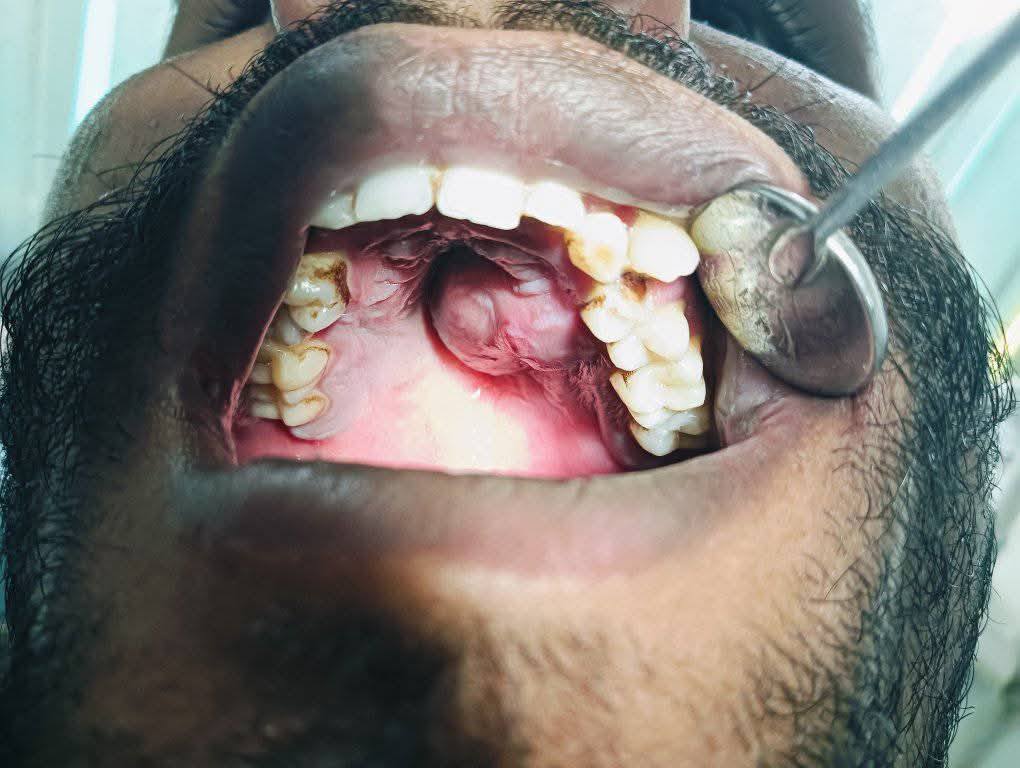
This patient has come to me with the complain of pain and swelling in mid palatine raphe 2days back.He took avloclav 625mg and the swelling is gradually increasing after taking this medicine.
Swelling is soft in consistency and caries present in upper 4 closely to the swelling and mild mobility present.
What are the differential diagnosis and the management protocol. Please share your knowledge and enlighten us.
Case Analysis: Mid-Palatal Swelling with Pain
A patient presents with pain and swelling in the mid-palatal raphe for 2 days, which has gradually increased despite taking Avloclav 625 mg (Amoxicillin + Clavulanic Acid). The swelling is soft in consistency, and caries is present in the upper 4 (first premolar), which is close to the swelling. There is also mild mobility of the affected tooth.
—
Differential Diagnosis
Considering the location (mid-palatal raphe), soft consistency, progressive swelling, and association with a carious tooth, possible differential diagnoses include:
1. Palatal Abscess (Most Likely)
Etiology: Spread of infection from deep caries in the upper premolar.
Clinical Features:
Painful, localized swelling in the palate.
Soft to fluctuant consistency with possible pus accumulation.
No fever initially, but may develop later.
2. Periapical Abscess with Sinus Tract Formation
Infection from the necrotic pulp of the upper 4 premolar spreading through bone into the palate.
3. Odontogenic Cyst (Radicular Cyst / Residual Cyst)
Usually slow-growing and associated with a non-vital tooth.
May have corticated borders on radiographs.
4. Benign or Malignant Palatal Tumors (Less Likely but Considered)
Pleomorphic Adenoma, Mucoepidermoid Carcinoma
More chronic, non-tender swelling
No acute pain unless secondarily infected
5. Deep Fungal Infection (Mucormycosis / Candidiasis)
Consider in immunocompromised patients (Diabetes, HIV).
Rapidly progressing necrotic ulceration if mucormycosis.
—
How to Confirm the Diagnosis?
Clinical Examination
Fluctuation Test → If positive, suggests abscess.
Pulp Vitality Test → Check whether the upper 4 is non-vital (Necrotic Pulp).
Palpation & Tenderness → If pus is localized, indicates abscess.
Radiographic Investigation
Periapical X-ray (IOPA) → Look for:
Periapical radiolucency (suggests periapical abscess)
Bone destruction in the palatal region
CBCT (If available) → Helps assess bone involvement and sinus communication.
Aspiration & Pus Culture
Needle Aspiration → Confirms presence of pus.
Pus Culture & Sensitivity Test → Identifies causative bacteria and guides antibiotic selection.
—
Management Protocol
1. Immediate Care (Symptomatic & Infection Control)
Incision & Drainage (I&D) → If pus is present
Warm saline rinses to reduce bacterial load
Pain Management: NSAIDs (Ibuprofen 400 mg/TID)
Antibiotic Adjustment (If No Improvement with Avloclav 625 mg)
Switch to Clindamycin 300 mg QID (if penicillin allergy)
Consider Metronidazole for anaerobic coverage
2. Definitive Treatment
Endodontic Therapy (RCT) → If the upper 4 is non-vital
Extraction → If tooth has poor prognosis (severe mobility, furcation involvement)
Surgical Drainage → If the swelling does not reduce
3. Follow-Up
Re-evaluate after 3–5 days
If swelling persists, repeat imaging to rule out deep-seated infections or cystic pathology.
—
Conclusion
Based on history and examination, palatal abscess secondary to periapical infection is the most probable diagnosis. IOPA + Pulp Vitality Test + Aspiration are essential for confirmation. I&D + Adjusted Antibiotics + RCT/Extraction should be done for definitive treatment. If symptoms persist, further investigations (CBCT, biopsy) should be considered.
Raiyyan Tahsan. Date:-21-05-2025 Wednesday Time:-05-48-55 Pm